

How can governments accelerate refugee labor market integration at scale?
Following Russia’s 2022 invasion of Ukraine, more than 1.2 million Ukrainian refugees arrived in Germany. In October 2023, the German Federal Ministry of Labour and Social Affairs and the Federal Employment Agency launched the Job-Turbo—a nationwide initiative aimed to accelerating employment among approximately 400,000 registered unemployed refugees. A team of researchers from the Immigration Policy Lab (IPL) at Stanford University and ETH Zurich, along with collaborators at University College London, the German Center for Integration and Migration Research (DeZIM), and Germany’s Federal Employment Agency, evaluated the program’s impact.
A shift in approach to refugee employment
Germany and many other European countries follow a “qualification-first” model, requiring refugees to complete language training and to undergo lengthy bureaucratic procedures for recognizing foreign credentials before entering the labor market. The Job-Turbo marked a clear departure from this traditional “qualification-first” approach. Instead, it adopted a pragmatic middle path: encouraging refugees to enter the labor market immediately upon completing basic language training, even without full credential recognition or advanced language certification. The program’s core mechanism consisted of intensified counseling in Germany’s 300 job centers operated by Federal Employment Agency and municipalities. Caseworkers at job centers were instructed to contact refugee clients roughly every six weeks, starting shortly before refugees completed their basic language training. These interactions included job referrals, application support, and structured guidance toward employment.
Exit-to-job rates nearly doubled for Ukrainian refugees
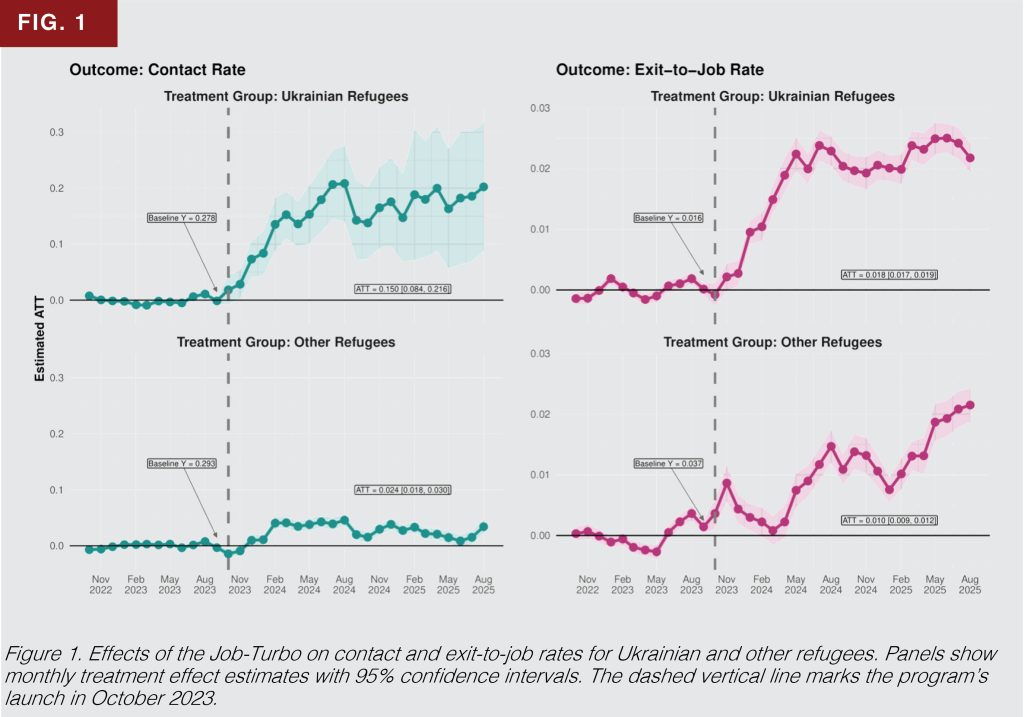
The results of the Job-Turbo are striking. Using monthly administrative data from 300 job centers and a difference-in-differences design, the study finds that the Job-Turbo significantly increased both caseworker-refugee contact and job placements. Contact between caseworkers and Ukrainian refugee clients rose by 15 percentage points, representing roughly 490,000 additional counseling interactions. The monthly exit-to-job rate among Ukrainian refugees increased by 1.8 percentage points—a 113 percent increase relative to the pre-program baseline, effectively doubling the rate at which unemployed Ukrainians transitioned into work. Over the 23-month follow-up period, this corresponds to an estimated 58,000 additional job placements (see Figure 1). For refugees from eight other major origin countries—including Afghanistan, Syria, Iraq, and Eritrea—the program also generated meaningful gains, increasing monthly exit-to-job rates by 1 percentage point (a 28 percent increase) and generating approximately 43,000 additional job placements.
Broad-based effects and sustained employment
For Ukrainian refugees, improvements in job placements are observed across all demographic subgroups, unemployment durations, skill levels, regions, and labor market conditions. Effects were similar for men and women. The vast majority of exits were into regular, unsubsidized employment rather than temporary or marginal “mini-jobs.” Importantly, the employment gains were not short-lived. Ukrainian refugees who entered employment through the program were more likely to remain employed at 3, 6, and even 12 months. Also, the share of placements resulting in sustained employment increased—indicating improved placement quality, not just quantity.
For other refugee groups, effects were concentrated among younger men in low-skilled jobs. Effects for women in this group were smaller and often not statistically significant, likely reflecting structural barriers such as childcare responsibilities, slower language acquisition, and limited transferability of credentials in regulated professions.
Limited evidence of displacement effects
A common concern is that prioritizing refugees could disadvantage other job seekers. Caseworkers might shift their effort toward refugees, while refugees themselves could potentially crowd out other job seekers. However, the analysis finds little evidence of supporting this concern. Looking at job centers with the highest concentration of refugees, the researchers found no changes in contact rates or exit-to-job rates for unemployed German nationals and other immigrants excluded from the Job-Turbo. The evidence suggests that existing caseworkers absorbed the additional workload, contacting roughly one additional client per staff member every two months, without any measurable increase in staffing levels.
Policy implications
The findings point to important benefits of early labor market activation in refugee integration, particularly in contrast to more restrictive qualification-first approaches used in Germany and elsewhere. They suggest that early and active employment support can generate substantial and sustained gains in refugee labor market integration. Existing public employment infrastructure can deliver these outcomes at scale. A cost-benefit analysis in the study indicates that within 12 months, increased tax revenues and reduced welfare expenditure per newly employed refugee begin to outweigh program costs. The findings are consistent with existing evidence suggesting that government policies that boost labor market access early in the integration journey are particularly impactful.
At the same time, intensified counseling alone is insufficient to address all barriers—particularly for refugee women from certain origin countries.
LOCATION
Germany
RESEARCH QUESTION
Can intensified employment counseling accelerate refugee labor market integration at scale?
TEAM
Jens Hainmueller
Stanford University, Immigration Policy Lab
Moritz Marbach
University College London, Immigration Policy Lab
Dominik Hangartner
ETH Zurich, Immigration Policy Lab
Niklas Harder
German Centre for Integration and Migration Research (DeZIM), Immigration Policy Lab
Ehsan Vallizadeh
Federal Employment Agency, University of Bamberg
RESEARCH DESIGN
Difference-in-differences with interactive fixed effects
KEY STAT
Among Ukrainian refugees, the exit-to-job rate nearly doubled. Over 23 months, the program generated an estimated 58,000 additional job placements for Ukrainians and 43,000 for other refugees—with little evidence for negative effects on other job seekers.